

Using Authority Well
A Review-Essay

LAST WEEK, I RECEIVED AN EMAIL thanking me for my interest in a complimentary copy of Dr Jonathan Leeman’s new book, Using Authority Well (2026), and stating that my copy is on the way. They also provided a PDF version for my reading pleasure, a zip file containing beautiful pictures of the book, and suggested quotes for sharing.
I made no such request, but if Dr Karen Swallow Prior has taught me anything, it’s that the call usually comes from outside the house. So, here I am, an institutional deconstructionist discussing a book ostensibly about maintaining institutional structures through the benevolent use of one’s power and authority in the home, church and at work. Just so you know, I won’t get to reviewing the whole book, but we’ll hit the high points.
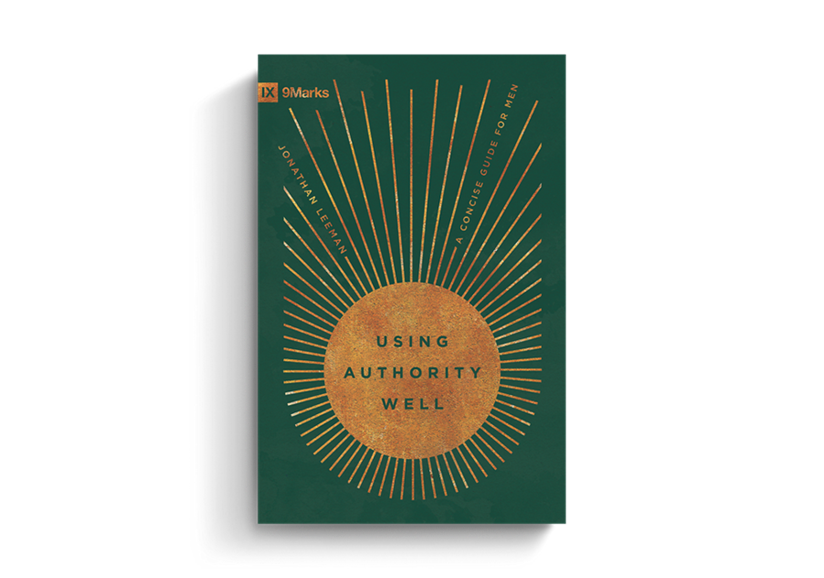
Using Authority Well
A Review-Essay
by Daniel L. Bacon
Using Authority Well is a book by Dr Jonathan Leeman, President of 9Marks, a Church Health ministry which focuses on promoting the nine marks of a Healthy Church.
“At 9Marks, we help pastors, future pastors, and church members build healthy churches. To this end, we create resources like books, podcasts, a quarterly journal, web courses, and more. We also host training events around the world. Our focus in everything is on nine marks of a healthy church—expositional preaching, gospel doctrine, conversion and evangelism, church membership, church discipline, discipleship and growth, church leadership, prayer, and missions. Why these nine? Because they’re biblical, and, sadly, too many evangelical churches have neglected or assumed them.”
Who We Are: 9Marks Website.

Dr Leeman is a prolific author and editor and has been published widely, including in The Gospel Coalition, Tabletalk Magazine and Canon and Culture. Dr Leeman is a Political Science graduate from the University of Rochester, earned his master’s degree in political theory from the University of Wales, and his PhD from Southern Theological Seminary, resulting in his book Political Church: The Local Assembly as an Embassy of Christ’s Rule (2016).
Within the 9Marks World, the ‘mark’ which this book addresses is Mark VII: Church Leadership.
“There are two church offices according to Scripture: elders and deacons. Elders are to be godly, qualified men who serve as teachers and shepherds of the church. Deacons, on the other hand, are servants of the church, focusing on practical needs of members and the unity of the whole body.”
Mark VII: Church Leadership from the 9Marks Website
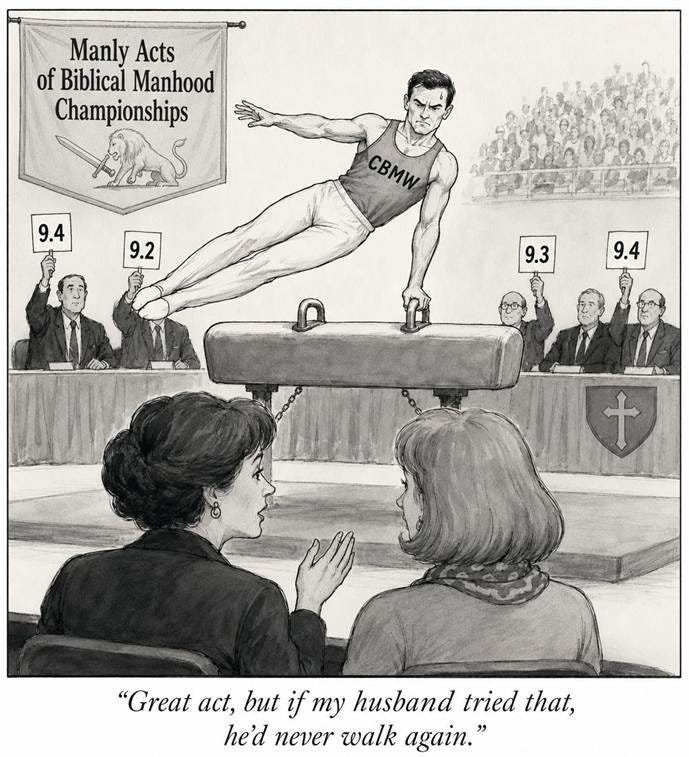
Having established this context, Using Authority Well poses confidently on the balancing bar that is complementarian patriarchy. There’s no outsized push toward a biological or competence-based argument for authority.1 I have previously stated that complementarianism is more of a non-stance, defined apophatically as the holy tension between equality and difference. This is the message we have been told repeatedly by TGC leadership and The Center for Biblical Manhood and Womanhood: equal in value but different in role. But I don’t think anyone but Complementarians are satisfied that this description constitutes anything but apologetic male dominance, which we attempt to bridle with congenial reins.
In a 2024 interview printed in the Southern Baptist Journal of Theology, Dr Leeman had this to say about what happens when a people group feels oppressed.
“When people feel oppressed, that is when they go looking for new theories to justify changing and switching the table. On the one hand, that might be a good thing. On the other hand, it might be a bad thing. But the nature of the historical moment often incentivizes our fresh theorizing, along with our fresh theologizing.”
Dr Jonathan Leeman 2024 Interview
Southern Baptist Journal of Theology Vol 28 No. 2 Summer 2024
He’s specifically talking about certain strains of Christian Nationalism as reaction groups of Christians who feel oppressed by the culture and their tendency towards granting power and authority to governments that rightly belong to the church. Against this, Dr Leeman defended a model of distinct God-ordained authorities, each operating within its proper jurisdiction, and insisted that Christ’s name belongs properly to the regenerate church, rejecting terms like Christian Nationalism as originating from outside the Church and Christianity, which, though the public appeal for Christian Nationalism is low, it is demonstratively not the case that they coined the term.2
In one sense, based on comments like this, Dr Leeman is aware of the political reality of what happens when a people feel oppressed: they look to throw off their oppressors and the systems that keep them in authority. But the connective tissue between oppressed people and oppressive systems that keep them down does not carry over in his writing about authority. His answer to oppression within the Church 3 is not to throw off the oppressor and the systems that keep them in authority, but to make those self-same authoritarians better leaders.4
In this way, Dr Leeman and I disagree on what constitutes the Christian Church. His framework treats the church as an institution by divine appointment5—a polis, an embassy of Christ’s kingdom on earth, possessing divinely delegated authority to recognise and govern the citizens of that kingdom.6 His dispute with Christian Nationalists such as Doug Wilson is not over the existence of authority but over its jurisdiction. Where Wilson appears willing to see the nation assume functions historically associated with Christendom, Dr Leeman argues that the Keys of the Kingdom belong exclusively to the church and must never be transferred to the state.
Critically, reading Using Authority Well is not going to give you this context. In this way, it is not a book for public consumption but specifically for men in Churches which align with Dr Leeman’s political theory.
Where we disagree is in the felt necessity to maintain overt titles of authority over one another without an evident substantial relationship. Ontological shortcuts are how abuse happens in the first place—I am (insert title here) and, as such, have divine authority over you. His system of authority does not prevent pastors from counselling the women in their churches to submit to their abusive husbands because, unlike the men to whom his book is written, submission does not result in being raised to higher authority for women—only in putting them in danger and forming them into poster-girls for patriarchy to whom little girls can look up to as an example and to whom little boys look for in a wife.
Dr Leeman bases his definition of moral reality on anything he deems God-ordained. This is an extension of what we’re used to hearing at this point—flat readings of Scripture that result in increased authority for men. But as a descriptor of moral reality, this definition fails the necessary universality checks. Communication, for example, is properly God-ordained to the point of universality. There is nothing anyone can do to silence another human being. Nothing. The Scriptures even attest to it:
“Therefore whatever you have said in the dark shall be heard in the light, and what you have whispered in private rooms shall be proclaimed on the housetops.”
Luke 12:3 ESV
God-ordained authority cannot be an institutional ontological reality in this sense. True Isness Power and Authority7 may intersect with whatever institution we belong to, but it is neither defined nor authorised by that institution. Elishah does not inherit Elijah’s mantle by default—it happens in a whirlwind of fire and is an uncertainty until the very moment it happens that Elishah sees Elijah being taken up, and according to Elijah’s prophecy, Elishah is given a double portion of his spirit. There is nobody else around—no one to confer Elijah’s authority onto Elishah, and yet it is so.
Elijah’s mantel is not an ontological reality such that the kings and rulers and the people of the land were morally obligated to take Elishah’s word for it. Neither were his signs and miracles an ontological shortcut for relationship.
We used to look to ordination as the way in which we bestow the recognition of our Christian communities of being possessed of isness power from God for a purpose, but being institutionalised and that institution being mistaken for the church giving authority over the past two thousand years has rendered ordination how we gerrymander the Kingdom of God.
Since writing Sex, Calling, Uncle Ben & Dinosaurs, which was a roaring success8 on this publication at 2.23K views and climbing, I’ve been thinking about complementarianism through the lens of vocation and calling—which, for me, doesn’t change the fact that if certain callings are sex-based, then in those callings, complementarianism isn’t meaningfully different from patriarchy.
We might express it in the abstract like this:
Dominion = Legitimised Traits x Social Recognition
The coefficient traits (sex, age, calling, competence, etc9) are what vary, so that each system might be expressed as:
Patriarchal Authority Structure | D = sex x age
Complementarian Authority Structure | D = sex x age x calling
Egalitarian Authority Structure | D ∝ age x competence x calling
In plain English, Patriarchal and Complementarian Authority Structures are based largely on fixed, sex-based authority; inclusion via male classification. When we use language like qualified male leadership, the constant, not the variable, represents the floor of the qualification for leadership. So, then the qualification process does not determine who may lead in general, but which males may lead.
Using Authority Well deals distinctly with complementarian authority, though it makes no outward argument for or even mention of it except in passing with indicators rather than outright statements of fact. This is a book on how men should rightly use their authority based on Dr Leeman’s assertion that being made in the image of God and presenting that positive image in the world means that we are born with an ever-increasing capacity for dominion over the world and are called by those with greater authority to exercise that capacity through pre-approved channels. The nature of the book is a compact, public version of Dr Leeman’s larger work Authority (2023), which I have not read, but which he helpfully points to at various times to indicate that a fuller argument than is stated can be found therein.
The Marketing
As it pertains to marketing, this book, about male authority, is marketed as A Comprehensive Guide for Men. Though it covers both male and female authority and while Dr Leeman’s complementarian language is present throughout, there are core pieces of his argument that do not rely on his Complementarianism to such a degree that his diagnostics, for instance, do not stand or fall on that complementarity. Had he been egalitarian or left out that language entirely, the book would stand on its own. But Dr Leeman is affiliated with The Gospel Coalition, which tends to weave complementarity into everything—even and especially the gospel.
Dr Leeman makes no attempt to establish or defend his complementarity but lets it stand as apparent; it is ultimately superfluous to the core of what he had to say about authority, which he applies to all people and not only men, which is to say that the marketing for this book is more suited to the complementarian add-on than to its actual message.
That said, as far as I can tell, there is no companion guide for women to edify them in how to use their authority well—I suppose their fathers and husbands will have to teach them after going through this study.10
Diagnostics
Dr Leeman offers the reader five diagnostics for one’s use of authority:
Good Authority Does Not Steal Life but Creates It
Good Authority is Not Unaccountable but Submits to a Higher Authority
Good Authority is Not Unteachable but Seeks Wisdom
Good Authority Is Neither Permissive nor Authoritarian but Administers Discipline
Good Authority Is Not Self-Protective but Bears the Costs
On their own, there is something quite compelling and self-evident about these diagnostics--really, too compelling to come under the impression that they are reliant even a little bit on the systems attaching themselves to this book. Perhaps it is intentional, since the jurisdictions Dr Leeman addresses don’t all concern Christianity directly11—but it’s worth examining these diagnostics through the transcendentals of Truth, Goodness, and Beauty.
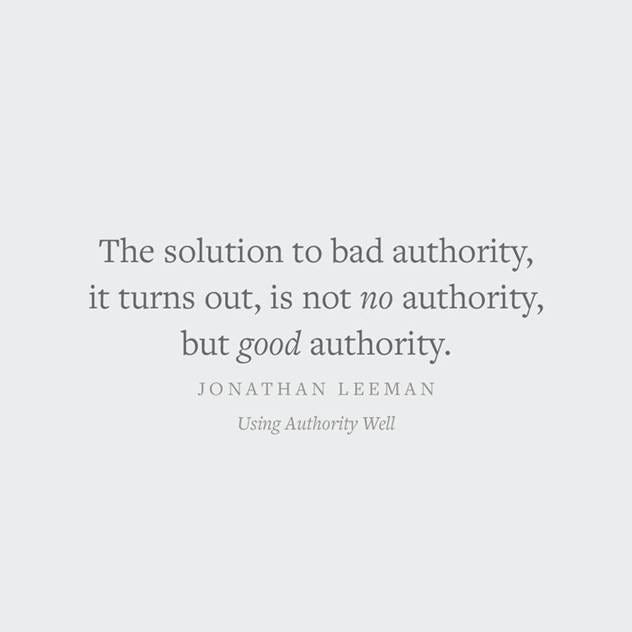
Dr Leeman is already working in the register of the Good when he writes, “The solution to bad authority, it turns out, is not no authority but good authority.” And then produces diagnostics to determine the quality of our authority—diagnostics which inevitably touch on the rest of the transcendentals.12 The issue is that if authority is intrinsically institutional and there are no meaningful checks and balances on that institution, then the ability of that institution and the persons therein to convey truth, goodness and beauty to the world is significantly hampered.
Power & Authority
Dr Leeman’s next move is to distinguish between power and authority, defining power as the ability to act and authority as the license to act. In this framing, authority is not primarily force or capacity, but delegated legitimacy.
This distinction aligns closely with the logic of the modern church-planting movement, in which existing authority functions as the mechanism by which new authority is recognised and conferred.
Throughout, it is helpful to understand Dr Leeman’s use of “authority” less as raw power and more precisely as licensed permission subject to jurisdiction—authority as something granted, recognised, and transmitted within an existing order rather than something inherent in capacity alone. Dr Leeman calls authority an office to which one is called, rather than the traditional conflation with leadership as influence, as put forward by Dr John Maxwell.13
Dr Leeman also comes very close here to recognising competency as a prerequisite for authority14 but locates it under raw power rather than authority proper and succeeds at maintaining the distinction between raw competence and influence and sanctioned, legitimate authority as recognised by existing authority. As a result, competency is effectively nullified as a prerequisite in favour of whatever other metrics we are considering. Worse still, unsanctioned influence is seen as a threat to authority at best and open rebellion at worst.
Authority, for Dr Leeman, is institutional by nature—for him, there is no legitimate authority except that which has been approved by an approved authority. Where competency is ignored as a qualification for authority, it weakens all authorities, even and especially credentialing authorities.
Consider Corinth—Apollos, Paul, Cephas, and Jesus Himself held influence in the Church at Corinth, and Paul could have easily discounted the others as unauthorised influences on the Church at Corinth when he wrote, “For though you have countless guides in Christ, you do not have many fathers. For I became your father in Christ Jesus through the gospel.” 1 Cor. 4:15 ESV. This is Paul’s opportunity to discount everyone here but Jesus, but he doesn’t. In fact, he’s just done saying, “For all things are yours, whether Paul or Apollos or Cephas or the world or life or death or the present or the future—all are yours, and you are Christ’s, and Christ is God’s.” 1 Cor 3:22-23 ESV
Dr Leeman grounds the claim of authority in the belief that we are inherently authoritative as image-bearers of God and are either using that authority well or we are not.
“Yet authority is not only a practical necessity. The story here is bigger than that. Exercising authority is how we image God…
We image him by ruling like he rules. Authority is not merely a necessary evil, as I’ve heard Christians say. It goes right to the heart of human existence, which means that authority can be a wonderful, life-giving thing”
Using Authority Well (2026)
A popular aphorism within these spaces is that “God doesn’t call the equipped; He equips the called.” If we do not qualify, we do not participate, so a license gives us the right to participate, and competency is merely how well we participate, not whether we should. So, we can understand this book as a book about growing in competency in our existing authority within our respective jurisdictions.
Writing this is, I think, the first time I’ve understood the reticence towards competence in the complementarian framing of authority in an anthropological sense. A mother and father are usually woefully incompetent with their first child, but in an ideal world, are surrounded by mature, competent adults who themselves had to traverse incompetence and are hopefully out on the other side.
However, we don’t escape competency as a prerequisite for authority, as the passages Dr Leeman cites insist that an Elder not be young and that they should have proved their competency already in running their household well. If leadership is a school of authority, as Dr Leeman suggests, it need not be a Nursery School in any iteration of home, work or church.
Further Analyses
The problem, as I see it, in all areas of leadership training is that we are training people for abstract leadership instead of training them for the job; to be true, good and beautiful people at their work and not only their work, but that their truth, goodness and beauty transcend every area of their life—and then are given authority. I saw this most clearly when I was a student at a 2-year conservative Bible College, where certain students were handpicked for leadership training and given authority as reporting officers in every dorm room and student job site. Both men and women were given authority, as Dr Leeman defines, special training sessions, and scheduled reports with their Discipleship Coordinators.
I was not one of those students and did not kick against the goads of my own Room Supervisor or Work Supervisor, but neither did I think they were particularly suitable for the position, as in more suitable than myself or any of the other students—at least not a first. Cut to 6 months down the line with special attention and training, and of course, they were more suitable then! At least, by the metric by which leadership was defined at our school.
Authority accentuated the character of each of those students because their paradigm told them that everything they had been doing had led to this moment, and that they had arrived and needed only to get better at who they are as leaders, and not necessarily as people. But no one is a paragon of virtue at 18 years old—least of all those of us who grew up in the bubble of Evangelical culture—we were ‘good’ because we were sheltered, not because we were well tested. Neither leadership nor compliance are a virtue. As the Early Modern15 poet John Milton attests,
“I cannot praise a fugitive and cloistered virtue, unexercised and unbreathed, that never sallies out and sees her adversary, but slinks out of the race where that immortal garland is to be run for, not without dust and heat. ”
-John Milton Areopagitica (1644)
Or as the esteemed Esau McCaulley testifies:
“There is a difference between avoiding egregious sins and the pursuit of God.”
-Esau McCaulley
The Cinderellafication of the Christian Woman
In the classic story of Cinderella, the principal conflict is between a matriarch and her stepdaughter. We, the viewers, watch scenes of the intentional subjugation of her deceased husband’s daughter to her own will and purpose to prop up her own lacklustre offspring for the marriage market.
Enter the Courtier announcing that by order of the King, all eligible women must appear before the Prince at his Ball, and the Stepmother pivots to stay on the right side of the law. She maintains that Cinderella may go to the Ball (maintaining an air of personal authority) if she finishes her chores, but then proceeds to sabotage the King’s summons. She does this by making it impossible for Cinderella to fulfil her secondary rules and regulations for attending. Keeping in mind that the Stepmother is also an eligible but admittedly unlikely candidate to be chosen by the prince, this verse comes to mind.
“ All who exalt themselves will be humbled, and all who humble themselves will be exalted.
13 “But woe to you, scribes and Pharisees, hypocrites! For you lock people out of the kingdom of heaven. For you do not go in yourselves, and when others are going in you stop them.”
Matthew 23:12-13 New Revised Standard Version Updated Edition
If sex-based dominion theology is akin to Gerrymandering, where the men draw bespoke lines around where their women are supposed to live as good Christian women, then the kind of behaviour that pretends that the virtues that vet our vocations and callings themselves are gendered is the equivalent of placing secondary tests to restrict voter turnout. Women just aren’t seen as eligible in the same way that Cinderella was not eligible—because she was kept busy doing what her abuser thought she should be doing. As a result, many Christian women who, by circumstance or their own sheer will, did not or could not participate in the principal domain of women in marriage, having children or making a home, devoted their lives to the ministry.
As Dr Beth Allison Barr points out in The Making of Biblical Womanhood (2021), the women who preached and exercised authority over men and women alike were overwhelmingly single, virgin, divorced, or widowed women, who, by the theology of their time, were considered to be closer to men than women.
The proverbial Fairy Godmother had paid them a visit and given them the “You shall go to the Ball” speech, but instead of a beautiful flowing dress and a carriage to showcase and present the truth, goodness and beauty of their femininity in a place of authority, they were given a power suit and a “girl-boss” mug and expected to conform to traditionally male spaces.
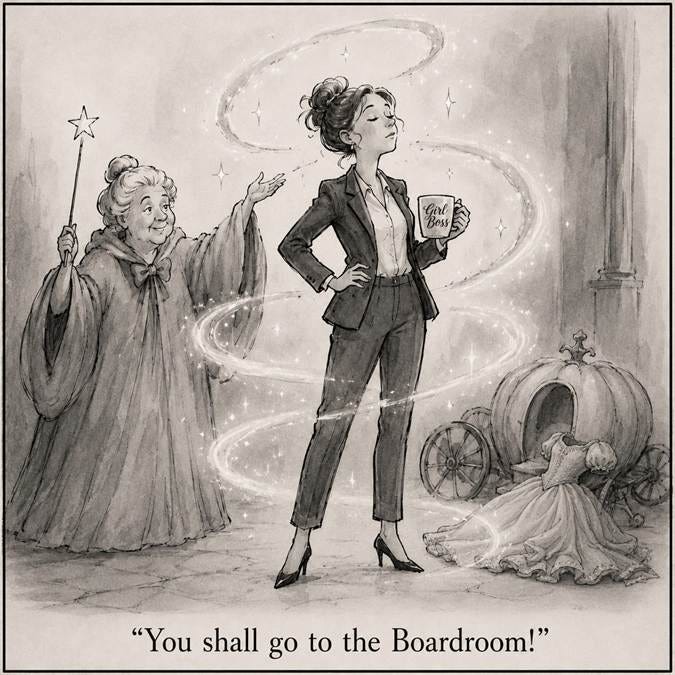
Now, what I’ve described is as much a legitimate form of feminine authority as any system a woman has touched and transformed by sheer willpower. Desire follows example as Dr Karen Swallow Prior reminds us in You Have a Calling (2025), and as such, what one woman can accomplish, all women could accomplish and still further, what authority one human holds, we all could hold. But here again we must say: just because we can doesn’t mean we should.
As a white male, I could hold the position of Grand Master of the Ku Klux Klan, or claim my position among the Aryan Brotherhood. I am the right race and sex to do it anyhow, but something tells me that no matter how winsome I can bring myself to be, the very position would impact my Christian witness in ways that would reflect poorly on Jesus. The same goes for both men and women who desire positions of authority, which themselves would corrupt their integrity and witness. This is where most Christians get off the institutional deconstruction bus.
Beep Beep
We can stomach the fact that some positions of authority in the world are off limits to us, but receiving the biological and racial call to those positions is harder to resist than most young people are comfortable resisting. We risk alienating our people by refusing to accept the mantle of these positions of authority. This is the risk that both women and men take when we conform to traditional sex-based jurisdictions. What should have us out of our seats, however, is not the exclusion of women from traditionally male spaces16 but the understanding that the whole paradigm fails to hold to moral reality in any sense whatsoever.
Conclusion:
Building social and theological structures on the basis of theologically expedient definitions, as can be found throughout Dr Leeman’s framework, strains our grasp on moral reality. What he calls moral responsibility often amounts to theological responsibility: fidelity to a system’s internal logic rather than fidelity to reality itself. The system presents an image of God, but an image is not the thing itself.
This is what ultimately separates my reading of authority from Dr Leeman’s. I agree that authority can be used well or badly. I agree that authority should create life, submit to higher goods, seek wisdom, administer discipline justly, and bear costs on behalf of others. These are compelling diagnostics precisely because they transcend the institutions to which Dr Leeman attaches them. They are true whether exercised by a man or a woman, a pastor, a parent, a manager, a neighbour, or a stranger.
Where we differ is that I do not believe authority becomes legitimate because an institution recognises it. Rather, institutions recognise authority imperfectly because authority already exists wherever truth, goodness, and beauty take responsibility for the world.
The irony of Using Authority Well is that its most persuasive insights point beyond the system that contains them. Its diagnostics invite us to judge authority by its fruit rather than its office, by its character rather than its credentials, and by its willingness to bear burdens rather than impose them. Once that move is made, authority ceases to be a possession and becomes a vocation.
The question, then, is not who has authority.
The question is whether the authority we claim reveals the reality of God or merely the architecture of our institutions.
This is in line with The Gospel Coalition’s policy to not appear as closet patriarchists or egalitarians, respectively.
The term was coined in 1942 to describe the longstanding relationship between Church and State. Christian National(ist/ism) is used pejoratively today because of the behaviour of those who fit the bill. Pew Research published a study of what 2,540 Americans had to say about Christian Nationalism in their 2022 study In their own words: How Americans describe ‘Christian nationalism’.
As in the case of his complementarian views
Not necessarily to put better, more qualified people in positions of authority, but to keep the same people in authority and arguably to give them more responsibility than they currently have, even though they’re hardly qualified and equipped to do the job they’re doing, because we don’t currently measure competency as a qualifying virtue in our leaders.
Regular readers will recognise The Appointment Model from The Isness of Power
“The Appointment Model posits that power is not a metric at all, but a position that can only be given. It is supernaturally attributed and naturally recognised, such that the natural aspects of power are superseded by the supernaturally ordained order. Texts like, “Man looks at the outward appearance but God looks at the heart,” 1 are appropriated to mean, “God has chosen this person. You may not like it, or understand it or agree with it, but tough cookies, “God works in mysterious ways”2. The deception of The Appointment Model is that power is meant to be practiced upon and over one another in a way that God seems to exercise power upon and over us.3 The fallout from the Appointment Model is that while we are quick to claim Divine Appointment we are much less likely to follow Divine Direction.” -The Isness of Power (2024)
My view is that the church is the people of God who have received mercy, nothing more, and nothing less.
True Isness Power is the power inherent to reality simply by virtue of its being. It is characterised by destituence, requiring no external authorisation, recognition, or conferral to exist. It is indelible, persisting regardless of denial, opposition, neglect, or acknowledgement. It is encountered primarily in the middle voice, as something that takes effect upon us and through us rather than being wholly possessed, controlled, or produced by us. Its efficacy arises from its existence itself; whether acted upon, resisted, ignored, or embraced, it remains what it is and continues to exert its formative influence.
Pun intended.
and probably a great many others.
Not going to happen.
Namely, the workplace, government, and in some cases, the family.
You will notice that because of the trajectory of the book and the transcendental nature of the diagnostic tool, not one of them is even remotely gendered.
See 21 Irrefutable Laws of Leadership (2007)
I would be interested in hearing how Dr Leeman connects authority with leadership, which other conservative authors have indicated has little or nothing to do with title and position, and which Dr Leeman equates with Authority.
Anathema to a complementarian.
Thank you, Dr Prior—embarrassing.
Though it is a travesty.
Lots to chew on here! I appreciate how you are teasing out power vs leadership vs authority in complementarianism. I was intrigued by your description of the “appointment model” of power… looking forward to digging into your archives a little bit to explore it.