

Not a Gospel Issue
(But Low-Key it's Giving Gospel Issue)

An unpublished essay that I wrote shortly after a couple book reviews and a very popular essay. Enjoy!
Original Intro:
In the last three weeks, I’ve reviewed two books and published my most popular essay on the Substack to date.1 While I’m on the proverbial roll, I want to address something I didn’t spend too much time talking about in Sex, Calling, Uncle Ben & Dinosaurs—how evangelical complementarian leaders come by complementarianism and why their appeal to the authority of scripture doesn’t make it any better.
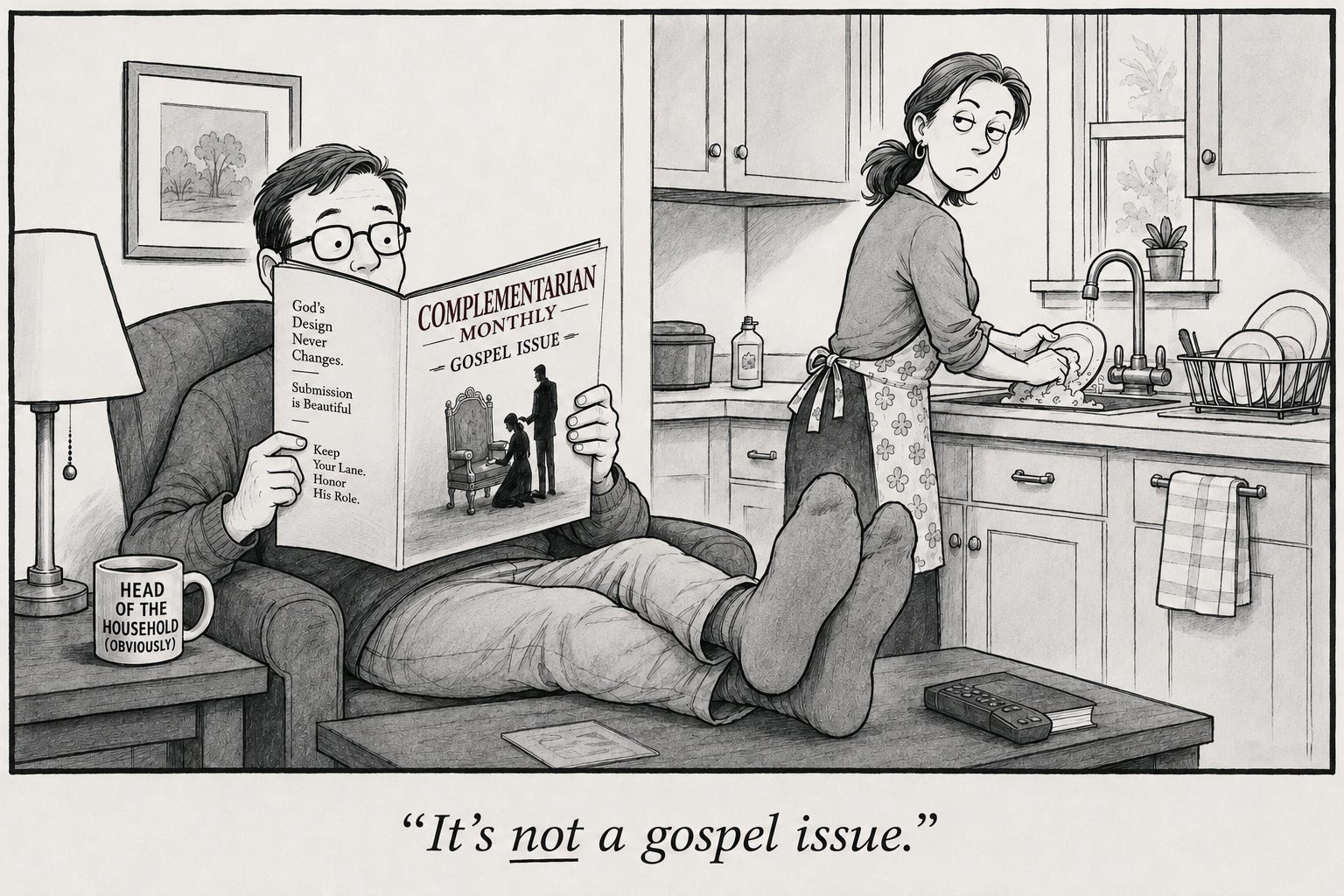
Not a Gospel Issue
(But Low-Key it’s Giving Gospel Issue)
By Daniel L. Bacon
THE OTHER DAY, I tuned into a podcast called Cults to Consciousness hosted by Shelise Ann Sola, an ex-Morman cult survivor, while researching the Stay at Home Daughter Movement, and the guest, Ashley Easter, said something that resonated with the headspace I’m in after reading Karen Swallow Prior’s You Have a Calling (2025) and Nicholas McDonald’s The Light in Our Eyes (2025).
Easter said that after leaving her father’s home and eventually getting married, desires that had been drilled into her from birth, which she hadn’t associated with the cult, surfaced in her marriage in the initial desire to have 10-14 children.2 But as the margin of time, distance, and a chill husband who’s down for whatever gave her space to become her own person, the maintenance of those desires came down to just herself, and without the symbol of the large families (7+ kids) of the cult or the belief in the cult’s 200 Year Quiverfull Plan, those desires started to change.3
Timestamp [42:56 - 44:18]
Shelise Ann Sola: So you still wanted to have lots of kids, even though you didn’t grow up in a really big family—that was your goal, right?
Ashley Easter: Right. I mean, there were other families at our church that had, you know, 7- 10 - 14 children, and you know, based on the information I was being given, that was ideal, and even to me seemed like that was what my mom’s desire had been if it was possible. That was my impression. And so yeah… I thought that was what I wanted because those were the options I was given and so even when I was starting to look at equality for women and talking about…egalitarianism…with my husband, and he’s very pro woman and all the things—I still thought that that was kind of part of my dream, but it wasn’t my dream and the further I stepped away from that the more I realised that this was something that was given to me by other people and was not something I would have come up with on my own.
Shelise Ann Sola: Yeah it was something that was told: this is what you want right? And then you kind of just have to go along with it, that’s how it was with Mormonism too is: you want to be a mom. And you just go: oh, yeah! Even if that’s not your goal.
This struck a chord with me in line with what we talked about in Sex, Calling, Uncle Ben & Dinosaurs where I called attention to the fact that when both male and female leaders in the conservative, complementarian world talk about when they became convinced of complementarianism, by their own testimonies it was when they knew next to nothing about the Scriptures and made this doctrinal decision as literal children in the faith. So here’s my question: do evangelicals understand complementarianism to be the case because of how they read the Scriptures, or do they understand the Scriptures because of how much they’ve invested in complementarianism?
In other words, they may be right, complementarianism might not be a gospel issue, but the Gospel is being treated as a Complementarian issue where Complementarianism is the overwhelming deciding factor for whether or not we can be associated with one another. Where one issue serves as the deciding line of exclusion, that issue is brought before all other issues as holding pre-eminence, in which case the Gospel Coalition can be honestly understood as the Complementarian Coalition, where the Gospel falls underneath the banner of Complementarianism.
The issue is that, by their own testimony, complementarianism is adopted as a wholesale juvenile understanding of Scripture that is then carried into adulthood in a protected, unexamined state. Imagine any other understanding that you had as a child, and bringing it forward unchanged into your adulthood, and this is effectively what is happening with complementarianism. Ask any conservative Bible teacher if they would recommend bringing childhood beliefs (even Christian ones) forward into adulthood, and I guarantee that even in the case of the Gospel, they will say that your understanding will likely be completely different, as it should be.
Complementarianism increasingly functions more as an identity marker whose social importance far exceeds the actual exegetical clarity behind it. They complain of persecution for their ideas and the abuse that flows from their communities as a result of those beliefs, but insist on maintaining complementarity as proof of their belief in the Authority of the Scriptures that don’t explicitly teach complementarity in the first place. In matters of complementarity, they permit the kind of hermeneutical readings that evangelicals are given to mock in flat-earth readings of “the four corners of the earth”.
The posturing that we are well used to fielding is, if we give ground on complementarity, we will give ground on the gospel!4 But no effort has been made, to my knowledge, to demonstrate the veracity of that statement. I don’t know any complementarian leader whom I’ve heard use this defence, who would give such disrespect to the gospel as to give it as flat a reading as they do of complementarian prooftexts. Their treatment of the gospel is generally a beautiful thing to behold, and precisely why their arguments for upholding Biblical Authority with such an indefensible position as complementarianism don’t hold water.
What strikes me is not that complementarian leaders hold complementarian convictions. It is that, by their own accounts, many of them arrived at those convictions before they possessed the biblical literacy they now insist is necessary to question them.
In every other area of Christian life we expect maturity to deepen, refine and sometimes overturn our earliest assumptions. We would never encourage someone to preserve a child’s understanding of the Trinity, the atonement, sanctification or the Church simply because they learned it young. We expect growth. We expect better questions. We expect a richer reading of Scripture.
Yet complementarianism is frequently treated as the one doctrine whose earliest formulation must be preserved untouched. The argument is no longer simply that Scripture teaches complementarianism. It becomes that questioning complementarianism is itself a threat to Scripture.
That is why I think the problem runs deeper than the doctrine itself. Complementarianism may not be a gospel issue. But when it becomes the primary test of fellowship, the defining marker of orthodoxy, and the lens through which every other biblical question must pass, it begins functioning as though it were. At that point, it is no longer complementarianism serving the gospel. The gospel is being asked to serve complementarianism.
Summer Ruminations:
Week 1:
The Crusader’s Dilemma

This might ruffle some feathers if anyone cares anything about what I write—which is doubtful, so it may be quiet. It’s a short one today. Summer offerings may look like this, this year: thoughts, ru…
Week 2:
Wilding

Good Monday morning, dear reader! These brief ruminations are proving manageable for Summer reading, and so we’ll continue. Last week was a little heavier discussing the nature of Christian Expansion…
Week 3:
Matthew Vines Wrote an Essay

I couldn’t justify keeping it to 500 words with this one. I hope this blesses and frees you.
1.88k views and several high-profile shares, including an in-the-wild mention by Orthodox Barbie that I will be riding high on for a while.
As number 4 of 6, even my eyes went wide.
Tale as old as time: Our message isn’t compelling enough, so we’ll breed them out—but to do that, everybody needs to have like 10 kids who have 10 kids, and in 200 years we’ll be in power.
This is a very common defence of many evangelical beliefs that rely on flat readings of the Scriptures, where a so-called plain reading serves our purpose just fine without adding nuance.
This is one of my favorite things you've ever written. Well-said, sir.