

Post-Institutional Evangelism
500+ Words About Sharing the Good News After Deconstruction

I don’t know that it’s right to say that I’m anti-institutional—I don’t think they’re going anywhere; they’re dangerous and should be treated with extreme caution to the point of destituent participation, but they have made themselves somewhat necessary via their expansionism and the promises they’ve made that they haven’t a hope of keeping. Safety, legitimacy and provision are only attained by pressing their definitions into small enough spaces and under such pressure that, when accidentally or intentionally released, the pressure causes such unimaginable devastation that we think we must need institutions to protect ourselves from institutions; a pact of mutually assured destruction. But after deconstruction, my mind wanders back to practices like Bible Study, Communal Prayer, Worship and Evangelism regularly; about what those practices might look like post-deconstruction. Here’s 500+ words about that.
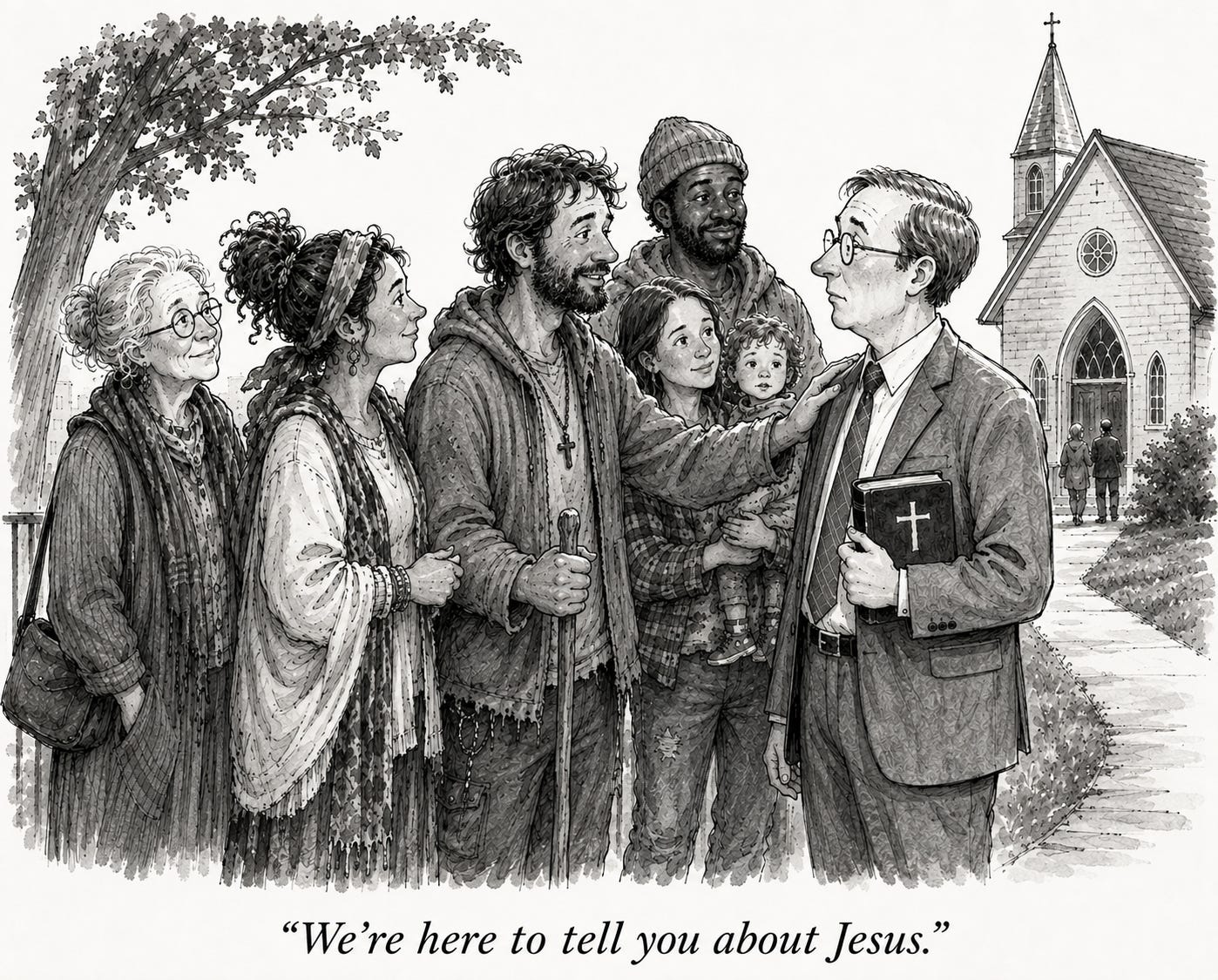
Post-Institutional Evangelism
500+ Words About Sharing the Good News After Deconstruction
by Daniel L. Bacon
“He has delivered us from the domain of darkness and transferred us to the kingdom of his beloved Son, in whom we have redemption, the forgiveness of sins. Fun, Food, and Fellowship.”
Colossians 1:13-14 ESV (My Fascitious Additions)
I DON’T BELIEVE IN ORGANISED RELIGION. I know—it’s a bummer.
It means I don’t have easy answers for exactly what I’m calling people to when I call them to a life of surrender to Christ. It means that I don’t have a standing Sunday meetup with a whole crowd of folks willing to pay my bills so that I will share my quiet time with them. It means my children are missing out on felt-board Jesus and Psalty the Singing Songbook. It means that even as I call people to Jesus, I am directing them away from the traditional discipleship funnel. So, what does it mean to share the good news of “God with us” apart from organised religion?
When I was rubbing shoulders with Church-folk, the main idea behind church growth was evangelical expansionism—we wanted more people to join the church for the right reasons. This meant that often we were turning away people we thought were there for the wrong reasons. We didn’t so much turn them away as make them incredibly uncomfortable so that they would leave, or withhold grace from our counsel, as was the case with one couple who were told that however in love they were, they needed to renounce their ungodly marriage and return to their first marriages.
Evangelism, however, was about bringing fresh people into the church—people who hadn’t had time to be confused by alternative ideologies or theologies or jaded by church hurt so we could disciple them into the most faithful kind of Christians of whom, of course, we were the best.
An interesting image used among evangelicals is to describe coming to Jesus by saying that, “God doesn’t have any grandchildren”—that is to say that the Church was a kind of divine Social Services that immediately took children away from their parents so they could be catechised in the way of the faithful, which preaches, but is sadly the cause of so much loss of lived wisdom in the Church. This results in a certain Lord of the Flies feel among the churches, both because they are male-dominated and because those men are all boys with enough education to be dangerous but not enough lived experience to be wise.
We must then renew our minds and purify our hearts of the institutional gospel; the expedient, constituent gospel that calls people to our earthly kingdoms as a means of Christian Expansionism at any cost. The Gospel according to moral reality is far more expansive than can be defined on a church’s “What We Believe” tab on their website. At this point, I don’t believe in Universalism as a rule—I think the Bible gives ample warning of the consequences of refusing Christ and that most of those warnings are levelled at professing believers and errant nations. The moral reality of life must also include the moral reality of death.
So if we can return to the Scriptures, we understand that Paul tells us that we have been transferred from darkness into light; from the world into Christ in whom we have redemption and forgiveness. Light sounds nice—it sounds gentle, but it is also harsh and revealing of what we would rather not reveal; the true state of our hearts and lives. It shows us the inadequacies of our expedient definitions; it offers redemption and forgiveness at the cost of our loyalty to the Kingdoms of this World out of which we call others before they are dragged down with them into nothing.
Summer Ruminations:
Week 1:

Week 2:

Week 3:

Week 4:

Week 5:

Week 6:

Week 7:
